Single-page App (SPA) vs Multi-page App (MPA): A Comprehensive Comparison
In today’s digital age, web applications have become an indispensable part of our lives. As technology advances and user expectations grow, the landscape of web applications continues to evolve, presenting developers and businesses with a multitude of choices.
At the forefront of this evolution lies the distinction between single-page applications (SPAs) and multi-page applications (MPAs). The choice between SPAs and MPAs is not merely a technical decision, it also involves considering the project’s requirements, user needs, and development constraints. It is crucial to understand the strengths and limitations of each approach to navigate this landscape.
In this comprehensive article, we will delve into the world of SPAs and MPAs, exploring their benefits, and drawbacks and also compare and contrast the two approaches.
1. What is a Web Application?
Definition
A web application is a computer program that is designed to run inside a web browser. Unlike traditional desktop applications that are installed on a user’s computer, web applications are accessed and executed from any device with an internet connection such as a desktop computer, a laptop, a smartphone or a tablet.
There are many famous web apps you may know, such as Gmail, Google Sheets, Google Docs… but you do not know they belong to web app type.
Web applications are typically written in HTML, CSS, and JavaScript, which are the fundamental languages of the World Wide Web. These languages allow developers to create interactive and dynamic web pages that can respond to user input and perform complex tasks. In addition to these core languages, web applications may also utilize a variety of frameworks and libraries to enhance their functionality and simplify their development.
Benefits of web apps
Web apps have become ubiquitous in the modern world, as they offer several advantages over traditional desktop applications.
- Platform-independent: Web apps can run on any device with a web browser, regardless of the operating system. This makes them accessible to a wider audience and eliminates the need to develop and distribute separate versions for different platforms
- Easy to update: Web apps can be updated centrally on the server, without requiring users to download and install new software. This ensures that users always have access to the latest features and bug fixes
- Scalable: Web apps can be easily scaled to accommodate a large number of users, as the server can be upgraded or replicated to handle increased traffic. This makes them suitable for apps that need to support a large user base.
- Cost-effective: Web apps are generally less expensive to develop and maintain than traditional desktop apps, as they do not require the same level of infrastructure and support.
Read more: Great Things You Need to Know About Web Application Development in 2025
2. Defining Single-Page Application (SPA)
Single-Page Applications is a type of web application that loads only once and then dynamically updates the page as the user interacts with it. Some examples of popular SPAs are: Gmail, Google Maps, Facebook. Twitter and Instagram…
Benefits of Single-Page Applications
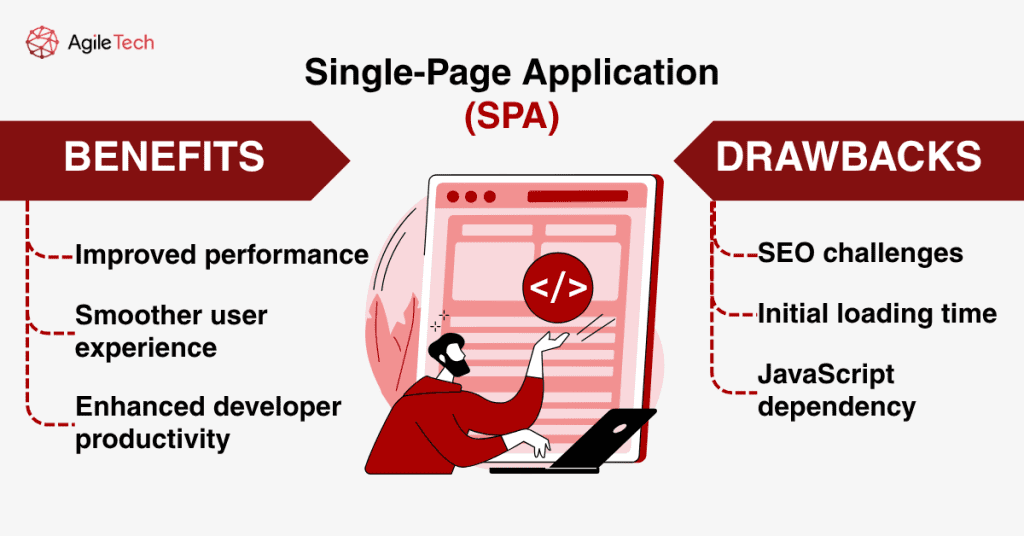
- Smoother user experience: SPAs provide a more seamless and responsive user experience, as there are no page reloads to disrupt the flow of the application. This can lead to increased user engagement and satisfaction.
- Improved performance: SPAs can often load and perform faster than MPAs, as they only need to load the initial HTML, CSS, and JavaScript code. This can be especially beneficial for applications that require real-time updates or complex data interactions.
- Enhanced developer productivity: SPAs can be easier to develop and maintain, as they often use frameworks that provide a more structured and organised approach to development. This can reduce the time and cost of development.
Drawbacks of Single-Page Applications
- SEO challenges: SPAs can be more difficult to optimize for search engines, as their content can be dynamically generated and may not be easily accessible to search engine crawlers. This can make it harder for users to find SPA-based applications through search engines.
- Initial loading time: While SPAs can perform well once they are loaded, they can have a longer initial loading time than MPAs, as they need to load all of the necessary code upfront. This can be a drawback for applications that need to be accessible to users with slow internet connections.
- JavaScript dependency: SPAs are heavily reliant on JavaScript, which means that they may not work well on browsers that have JavaScript disabled or have outdated JavaScript engines. This can limit the accessibility of SPA-based applications.
3. Delving into Multi-Page Application (MPA)
Multi-page application (MPAs) is a type of web application that loads a new page each time the user navigates to a different section of the application.
MPAs have been around for much longer than SPAs and are still widely used today. Google Search, Amazon, eBay, Medium and WordPress are some of the popular examples of MPAs.
Benefits of Multi-Page Applications
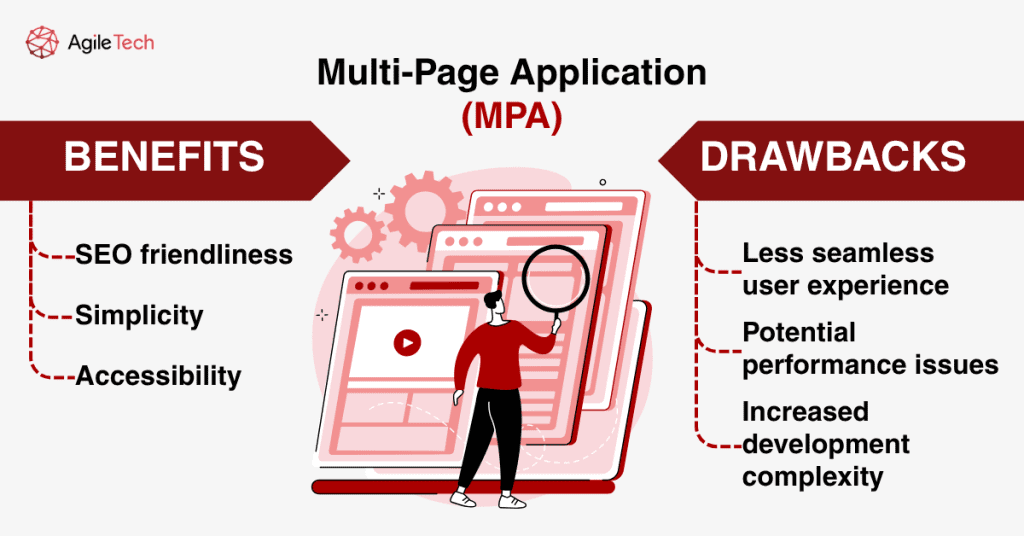
- SEO friendliness: MPAs are typically easier to optimise for search engines, as their content is organised into separate pages that can be easily indexed by search engine crawlers. This can make it easier for users to find MPA-based applications through search engines.
- Simplicity: MPAs are generally simpler to develop and maintain than SPAs, as they do not require the use of complex frameworks or JavaScript-heavy libraries. This can make them a good choice for smaller projects or projects with limited development resources.
- Accessibility: MPAs are typically more accessible to users with older browsers or JavaScript disabled, as they do not rely heavily on JavaScript for their functionality. This can make them a good choice for applications that need to reach a wider audience.
Drawbacks of Multi-Page Applications
- Less seamless user experience: MPAs can provide a less seamless user experience than SPAs, as there are page reloads that can disrupt the flow of the application. This can lead to a less engaging user experience.
- Potential performance issues: MPAs can have performance issues, especially if they are not carefully designed and optimised. This can be especially problematic for applications that require real-time updates or complex data interactions.
- Increased development complexity: As applications grow in size and complexity, MPAs can become more difficult to manage and develop. This can lead to increased development costs and maintenance overhead.
4. Head-to-Head Comparison: SPAs vs. MPAs
Before diving deeper into choosing the better one between SPAs and MPAs, let’s take a quick look at the key differences between them
| Features | Single-page application (SPA) | Multi-page application (MPA) |
|---|---|---|
| Loading | Only once | Loads a new page each time the user navigates to a different section of the app |
| Tech stack | Front-end: Angular, React, Vue. Vue.js Back-end: Node.js | HTML, CSS, JavaScript |
| Usage | For interactive or complicated web apps | For both simple and complicated web apps |
| Coupling | Front-end and back-end are more interdependent coding is usually housed under one project | Front-end and back-end are more interdependentAll coding is usually housed under one project |
4.1. Performance and User Experience
SPAs only need to load the initial HTML, CSS, and JavaScript code, while MPAs need to load a new page, even the footer, each time the user navigates to a different section of the application. As a result, SPAs could have a faster perceived loading time than MPAs.
Moreover, a study by Akamai in 2017 found that SPAs have a lower bounce rate (the percentage of users who leave a website after viewing only one page) than MPAs. This is because SPAs provide a more seamless user experience, as there are no page reloads to disrupt the flow of the application.
SPAs can handle real-time updates efficiently, while MPAs may require additional effort to implement real-time updates. For example, the Gmail SPA is able to update the inbox with new emails in real time, without requiring the user to refresh the page. This is in contrast to the older MPA version of Gmail, which required users to refresh the page to see new emails.
SPAs’ UX overall is typically more engaging, due to some reasons, such as the absence of page reloads, more fluid and intuitive navigation and dynamical updates, leading to higher user engagement. MPAs’ UX may feel seamless, as users have to click links to navigate between pages and wait for page reloading to update.
In terms of memory usage, SPAs may consume more memory than MPAs, because the entire application is loaded at once, while only the currently active page of a MPA is loaded. MPAs are also infinitely scalable. It is hard for developers to make a SPA scalable as they might need to write big chunks of code.
4.2. SEO
Single-page applications (SPAs) and multi-page applications (MPAs) differ in their approach to web development, and this distinction has implications for search engine optimization (SEO).
MPAs, with their traditional page structure, typically present fewer challenges for search engine crawlers, which readily index individual pages based on their clear URLs and metatags. This straightforward arrangement makes it easier for search engines to understand and rank MPAs. In contrast, SPAs, with their dynamic content and single-page architecture, pose a greater SEO challenge. Search engine crawlers may struggle to parse and index the entire application, as the content is not readily accessible through separate URLs. This can pose a difficulty in acquiring backlinks to specific sections of the apps.
It may be more difficult for SPAs to implement and manage meta tags and titles for individual pages, as the entire application is loaded into a single JavaScript bundle. MPAs are generally easier to implement and manage meta tags and titles for individual pages, which have their own HTML file.
4.3. JavaScript dependency
SPAs are heavily dependent on JavaScript, as they rely on JavaScript to dynamically update the page content without reloading the entire page. This heavy reliance on JavaScript can make SPAs less accessible to users with older browsers or JavaScript disabled.
MPAs, on the other hand, are less reliant on JavaScript. They can function to a certain extent without JavaScript, as each page is loaded independently and rendered by the browser. This makes MPAs more accessible to a wider audience, including users with older browsers or JavaScript disabled.
However, the increased use of JavaScript in SPAs can also bring some benefits. JavaScript allows for more interactive and responsive user interfaces, as well as the ability to handle complex data interactions and real-time updates. This can make SPAs a good choice for applications that require these features.
4.4. Complexity and Development
SPAs are typically more complex to develop, as they require a deeper understanding of JavaScript and modern web development frameworks. They also require more upfront planning and design, as the entire application is loaded at once. However, SPAs can also offer some development benefits. SPAs can be more maintainable in the long run, as the entire application is contained within a single codebase.
MPAs are generally simpler to develop, as they can be built using more traditional web development techniques and do not require the use of complex frameworks. They also require less upfront planning and design, as each page can be developed independently.
4.5. Security
SPAs, by their nature of being a single-page application, may present a larger attack surface for malicious actors, as they can potentially exploit vulnerabilities in the entire application codebase. Additionally, the use of JavaScript in SPAs can introduce additional security risks, as JavaScript code can be executed directly in the user’s browser, potentially allowing attackers to steal sensitive data or hijack the user’s browser session.
MPAs, on the other hand, may offer some security advantages due to their separation of concerns, as each page is loaded independently and can be sandboxed, limiting the potential damage caused by a compromised page. Additionally, the use of traditional web development techniques in MPAs may reduce the likelihood of certain types of vulnerabilities, as these techniques have been well-vetted over time.
However, MPAs are not without their security risks. Common vulnerabilities such as cross-site scripting (XSS) and SQL injection can still be exploited in MPAs, and these vulnerabilities can have serious consequences. Additionally, MPAs may be more susceptible to certain types of attacks, such as session hijacking, due to the fact that each page is loaded independently and may not have the same level of security checks as the application’s main entry point.
4.6. Total Expense
The total expense of developing and maintaining a single-page application (SPA) or a multi-page application (MPA) can vary depending on the complexity of the application, the development team’s experience, and the ongoing maintenance costs. However, in general, SPAs tend to be more expensive to develop and maintain than MPAs. This is because SPAs require a deeper understanding of JavaScript and modern web development frameworks, which can lead to higher development costs. Additionally, the dynamic nature of SPAs can make them more difficult to test and debug, which can also increase development costs.
MPAs can be developed using more traditional web development techniques, which can reduce development costs. Additionally, MPAs are generally simpler to maintain, as each page can be updated independently.
However, SPAs can offer some cost savings in the long run. SPAs can be more scalable, as they can handle large numbers of concurrent users more easily.
5. Choosing the Right Approach: SPAs vs. MPAs for Your Project
SPAs are well-suited for applications that require a high level of interactivity, responsiveness, and real-time updates. They may be real-time chat apps, collaborative editing tools, data visualisation dashboards… This is because SPAs can dynamically update the page content without reloading the entire page, which makes for a more fluid and responsive user experience. SPAs are also a good choice for applications that require complex data interactions, as they can handle large amounts of data efficiently.
MPAs are a good choice for applications that prioritise SEO, simplicity, and accessibility. This is because MPAs are easier for search engine crawlers to index, as each page has its URL and metatags. MPAs are also simpler to develop and maintain, as each page can be developed and updated independently. Additionally, MPAs are more accessible to users with older browsers or JavaScript disabled, as they do not rely heavily on JavaScript for their functionality. Some examples of suitable applications for MPAs include E-commerce websites, news websites, blogs, company websites…
Conclusion
To wrap up, while both types of applications serve the common purpose of delivering content and functionality through a web browser, they differ significantly in their architecture, performance, and suitability for specific use cases. SPAs are often preferred for applications that demand high interactivity, real-time updates, and a fluid user journey, while MPAS are well-suited for apps that prioritise SEO, accessibility, and adaptability to various devices.
Hope that this article will equip you with valuable information to make informed decisions about the best approach for your web application project, ensuring that you deliver a user-centric and successful solution.
If you are looking for a technical partner to assist you in accelerating your time to market with an intense experience in web app development, AgileTech is always here and provides you with the best services. We have a proven record of building high-quality web apps for clients around the world. If you need further information and consultation for your project, feel free to fill out this form to meet our IT experts!